




Tony’s Chocolonely seeks to end structural poverty and establish more equitable relationships with cocoa cooperatives in Ghana and Côte d’Ivoire.
CHOCOLATE WITH A CONSCIENCE
Côte d’Ivoire is the world’s largest cocoa producer, supplying over 40 percent of the world’s cocoa.
Neighbouring Ghana is also a leading cocoa production force in its own right, accounting for around 20 percent of global cocoa production.
However, climate shocks and crop diseases have caused yields to decline in the two West African countries, whilst there has also been a systematic lack of investment in cocoa farmers and their farms because of poverty, resulting in child labour and deforestation.
Tony’s Chocolonely (Tony’s), whose vision is to end exploitation in the cocoa industry, addresses these issues.
The impact company was founded in 2005 by three journalists from the Dutch TV show, ‘Keuringsdienst van Waarde’, after they discovered the world’s largest chocolate manufacturers were buying cocoa from plantations that used child labour and modern slavery.
Since then, Tony’s has dedicated its efforts to raising awareness of and eliminating inequality in the chocolate industry.
Responsibly sourcing cocoa isn’t just the right thing to do for Tony’s – it’s the smartest way to protect the future of chocolate.
Improved farming practices mean better cocoa beans and tastier chocolate, proving ethics and indulgence can go hand-in-hand.
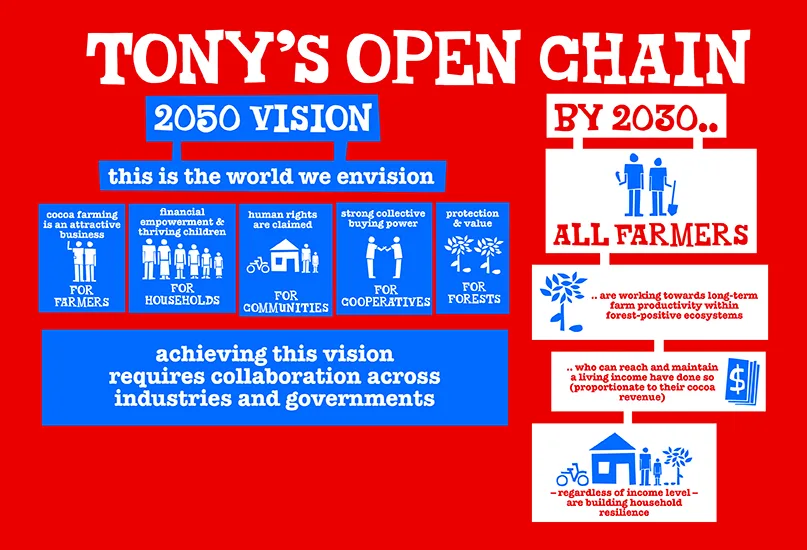
TONY’S OPEN CHAIN
Tony’s leads by example, building direct, long-term relationships with cocoa farmers in Côte d’Ivoire and Ghana, paying them a higher price, and working together to solve the underlying causes of cocoa’s three biggest issues – forced labour, child labour, and deforestation.
All cocoa beans used by the company are sourced through Tony’s Open Chain, ensuring resilience for farmers and premium-quality beans.
The model’s ‘5 Sourcing Principles’ – traceability, higher prices, long-term commitments, strong farmer partnerships, and enhanced quality and productivity – enable farmers to earn a living income and build long-term partnerships.
This farmer-first approach in cocoa prioritises human rights and environmental protection, aiming to reverse institutionalised inequality.
By combining its ‘5 Sourcing Principles’, Tony’s Open Chain seeks to end structural poverty and establish more equitable relationships with cocoa cooperatives in Ghana and Côte d’Ivoire.
Traceable sourcing is responsible sourcing, and the model offers this across three levels – operational, environmental, and social.
These are essential to Tony’s Open Chain’s commitment to transparency and accountability throughout the cocoa supply chain.
Tony’s uses its proprietary bean tracking software, BeanTracker, to know exactly where, when, how, and by whom beans were harvested and how they travel through the value chain.
Thus, the company ensures 100 percent traceability of Tony’s Open Chain-sourced cocoa, compared to lows of 40 percent for other industry players.
INCREASING INCOME
Inequality has historically defined the cocoa industry, with the majority of cocoa farmers in Côte d’Ivoire and Ghana living in poverty as a result of being underpaid for their produce.
Cocoa farmers often struggle to earn enough to cover their basic living costs, including necessities such as food, decent housing, education, and healthcare.
Despite their hard work and, in many cases, multiple income sources – from farming as well as non-farming activities – many cocoa farmers still fall short of what is needed to achieve a dignified standard of living.
In Côte d’Ivoire and Ghana, Tony’s pays the Living Income Reference Price (LIRP) for all cocoa beans sourced via the model, as set by Fairtrade.
Efforts to support and enable cocoa farmers to lift themselves out of poverty often emphasise increasing their responsibilities, such as improving cocoa quality, adopting better agricultural practices, boosting productivity, or diversifying their income sources – however, this focus absolves companies of their responsibilities.
A more effective strategy involves recognising a wide diversity of local contexts, household types, and different abilities and ambitions, as well as a balanced combination of interventions, which includes guaranteeing higher cocoa prices over multiple seasons.
Tony’s Open Chain ensures a higher price is paid for cocoa, a responsible purchasing practice that helps increase incomes for smallholder cocoa farmers.
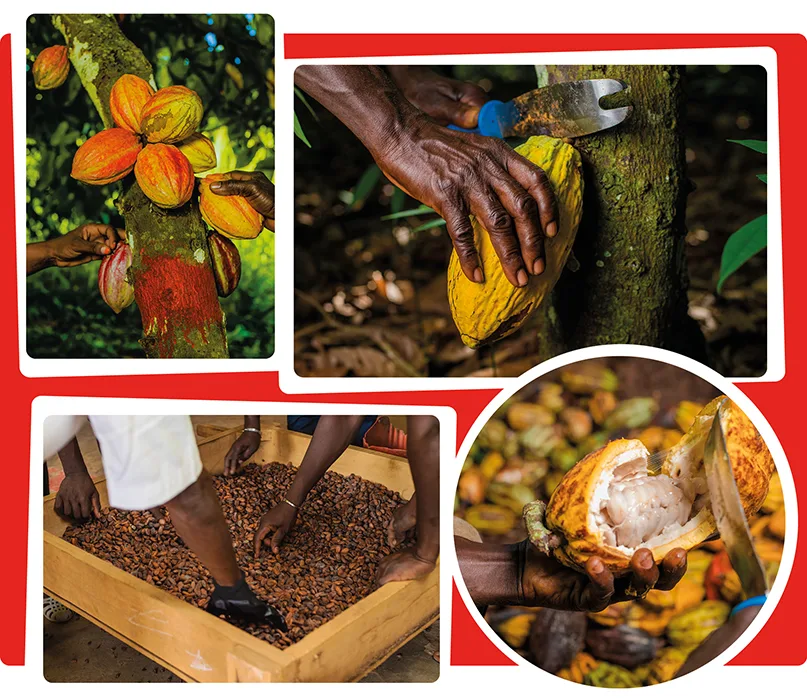
The long-term commitment to higher cocoa prices translates into economic stability, better financial planning, and the ability to invest in farm improvements, such as planting new trees.
COOPERATIVE-CENTRIC
Professional farming cooperatives and farms are promoted by Tony’s Open Chain, giving farmers and their self-organised groups the power to structurally change inequality.
The model is anchored in a cooperative-centric approach; partner cooperatives are key to ensuring safe, sustainable cocoa farming, serve as a direct link between cocoa farmers and Tony’s Open Chain, and play a critical role in supporting farmer members on their behalf.
Tony’s is proud to support the strength-building of its partner cooperatives as they own the implementation of the model’s ‘5 Sourcing Principles’, which are ingrained in their business practices.
As partner cooperatives mature and professionalise, they provide valuable insights on the application of these principles.
Tony’s Open Chain helps farmers to professionalise by investing in agricultural knowledge and skills, as well as organising labour brigades.
Collectively, the model’s ‘5 Sourcing Principles’ prioritise human rights and environmental protection in cocoa sourcing and purchasing, which is essential to addressing and reversing decades of institutionalised inequalities within the sector.
These principles need to be combined to offer a concrete solution to end structural poverty at the beginning of the supply chain, by fostering long-term change and establishing more equal business relationships with cocoa partner cooperatives in Côte d’Ivoire and Ghana.
This article was produced by the editorial team at Africa Outlook and published as part of the Outlook Publishing global network of B2B industry magazines.
Outlook Publishing delivers industry insights, company stories, and sector coverage across manufacturing, mining, construction, healthcare, supply chains, food production, and sustainability.
Africa Outlook provides ongoing coverage of organisations and developments shaping industries across Africa.