





Overcoming adversity in the continent’s maritime landscape, ports in Eastern and Southern Africa are experiencing a flurry of investment and renewed global interest, granting access to modern infrastructure and sustainable practices.
SPOTLIGHT ON EAST AND SOUTHERN AFRICAN PORTS
Flanked by the Indian and Atlantic Oceans, East and Southern Africa boast an abundance of aquatic and marine resources, which are increasingly being tapped into for global trade commerce and economic growth.
Indeed, the two regions place high dependency on international exports of raw materials, whilst relying heavily on imports of food, manufactured goods, and fuel from neighbouring areas.
Yet, compared to their international shipping counterparts, East and Southern Africa face challenges in infrastructure development and the effective communication of maritime information, which impede on sustainable development and economic diversification.
In addition, despite handing millions of tonnes (t) of freight per year, many ports still use ageing infrastructure which, compounded by limited berth space and cargo handling facilities, results in high congestion, waiting times, and costs.
As such, the industry is calling for increased infrastructure development, optimisation of fundamental processes, and implementation of modern technologies.
In response to these challenges, governments in East and Southern Africa, as well as external private investors, have funnelled money into expanding port space and improving container handling technology.
These investments, together with streamlined bureaucratic processes, are paving the way for greater efficiencies and gradual modernisation.
This is demonstrated by the rise of sustainability-driven practices and a growing focus on reducing carbon emissions, particularly within Southern African port activity.
In East Africa, the port logistics industry is enjoying significant investment that is funding digital customs systems and multimodal transport corridors.
Within this context, ports in East and Southern Africa are increasingly becoming key hubs for trade between Europe and the Middle East.
UNITING THE CONTINENT
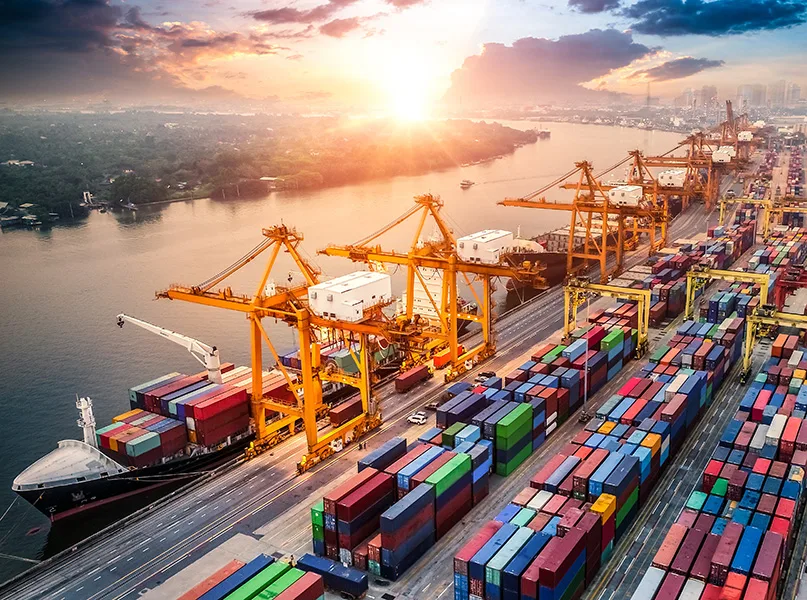
The main ports across Southern Africa include the Port of Durban, South Africa’s most active container port, which processes 2.7 million twenty-foot equivalent units (TEUs) and is fitted with modern container handling facilities.
The Ports of Cape Town and Port Elizabeth likewise enjoy cutting-edge logistics equipment, with the former primarily focused on the exportation of agricultural products using advanced cold storage facilities and the latter integral to trade between Europe and Asia, populated with automotive and bulk commodity terminals.
Elsewhere in Southern Africa, the Port of Beira in Mozambique is used by neighbouring Zimbabwe and Zambia and has recently enjoyed a flurry of investment to advance its efficiency.
Over in East Africa, the Port of Mombasa in Kenya is the region’s largest port, handling over 25 million t of cargo annually across Kenya, Uganda, Rwanda, and South Sudan.
In Tanzania, meanwhile, the Port of Dar es Salaam acts as a gateway for trade across Africa’s Central Corridor, granting access to imported goods for landlocked countries across the continent including Rwanda, Burundi, and Uganda.
The African Continental Free Trade Area (AfCFTA), established in 2019, has further boosted inter-regional trade throughout the continent, and modern port logistics across East Africa is integral to this.
The port industry across East and Southern Africa serves to unite the continent, both internally through key trade routes and internationally as a gateway between continents.
After decades of challenges stagnating its growth, the ports sector in both regions is set to be at the forefront of Africa’s logistics transformation.
THE PORT MANAGEMENT ASSOCIATION OF EASTERN AND SOUTHERN AFRICA
We showcase the Ports Management Association of Eastern and Southern Africa, which acts as a crucial framework for exchanging information and best practices across the industry.
Established in April 1971, the Port Management Association of Eastern and Southern Africa (PMAESA) is a non-profit, inter-governmental organisation responsible for creating an enabling environment for members to connect across port management, transport, and trade.
Open to a vast remit of member operators that span both regions, the association comprises port authorities, terminal operators, government line ministries, and logistics and maritime service providers.
Uniquely, as well as East and Southern Africa, the association also includes shipping stakeholders from the Western Africa and Indian Ocean region.
PMAESA’s principal aim is to strengthen the connection between member ports, with the overarching objective of fostering regional cooperation and integration, thereby reinforcing the industry’s ongoing transformation.
This is achieved through a comprehensive framework built by collecting, analysing, and disseminating vital information to members to aid their decision-making, further supported by regional networking events and conferences.
PMAESA works to improve the operations, competitiveness, safety, security, and protection of the port environment, with the ultimate aim of advancing the productivity of ports in East and Southern Africa.
PROMOTING REGIONAL EFFICIENCY
PMAESA members enjoy a wealth of both direct and indirect benefits; principally, the association builds awareness around changing dynamics in the regional maritime industry.
It also leverages a comprehensive outreach strategy whereby members are represented in the relevant organisations that shape global policy and facilitate new requirements in maritime trade, including economic commissions like the East African Community (EAC), Southern African Development Community (SADC), and Common Market for Eastern and Southern Africa (COMESA).
The association proactively communicates with various United Nations (UN) bodies such as the International Maritime Organisation (IMO) and UN Economic Commission for Africa (ECA) on behalf of its members, alongside other global maritime associations including the International Association of Ports and Harbours (IAPH).
Moreover, PMAESA provides valuable networking opportunities for its members to connect with neighbouring port operators, including those from the Ports Management Association of West and Central Africa (PMAWCA) and the North African Port Management Association (NAPMA).
Together, these three associations established the Pan-African Association for Port Cooperation (PAPC), a key source of connection for the continent’s port operators.
Members are afforded additional cross-sector networking opportunities during mid-term workshops and end-of-year global conferences, which are attended by C-suite executives from a wealth of areas including transport, trade, and investment.
Such events allow port operators to expand their network further across sectors and geographies, engaging with key partners in Africa, Europe, Asia, Australia, and North and South America.
For instance, PMAESA recently hosted a high-level delegation from India to explore the potential for partnership across the African ports sector, with a particular focus on ship repair services and maritime education and training.

PMAESA’S STRATEGIC PLAN
In line with PMAESA’s overarching vision to foster regional integration and global competitiveness across port operators in East and Southern Africa, the association launched its Strategic Plan 2024-2028.
The strategy was introduced as a roadmap for critical projects and programmes that will elevate productivity and enable ports to have an even greater impact on African trade.
PMAESA’s activities and flagship projects during the Strategic Plan 2024-2028 include:
Implementing the Toolkit for Green Port Development, which will advance sustainable practices amongst ports across the region.
Reviving the Cruise Africa brand and developing the Cruise Africa Strategy, aimed at bolstering the cruise tourism sector.
Developing and executing the PMAESA Strategy for Africa Green Port Development, emphasising sustainable programmes.
Creating wellness initiatives to improve the health and welfare of operators in multimodal transport corridors.

Establishing an ‘African Ports Connectivity Portal’, which can be used as an observatory platform for port statistics that will be regularly updated to provide accurate and timely data on ongoing activities.
Creating a ‘Pool of Experts Portal’ on the PMAESA website to streamline operations, improve communication, and allow members to access specialised knowledge.
Updating the association’s website and maintenance, including licensing, periodic reviews, updates, and security safeguards, to enhance the user experience and functionality.
Underpinned by 45 years of experience and equipped with a forward-thinking strategy, PMAESA is well-positioned as a centre of excellence for its members, ensuring optimum efficiency for ports across East and Southern Africa.
PORTS MANAGEMENT ASSOCIATION OF EASTERN AND SOUTHERN AFRICA PARTNER