






Zambia’s largest fast-moving consumer goods manufacturer, Trade Kings Group, has an expanding ecosystem of brands that remain both relevant and scalable. Mohsin Patel, Director, tells the story of the locally grown business that is unafraid to keep building.
A STORY OF AFRICAN MANUFACTURING
Zambia is one of the most exciting fast-moving consumer goods (FMCG) markets in Africa, precisely because it is not an easy one – the sector rewards businesses that can manufacture efficiently, price intelligently, and keep products consistently available.
As it evolves, the nation’s FMCG space is experiencing strong demand, granting burgeoning local brands room to gain ground.
“However, it is also a market that quickly exposes weak operating models. If manufacturing is inconsistent, route to market is weak, or there is heavy reliance on imports, Zambia will test you very quickly,” opens Mohsin Patel, Director of Trade Kings Group (Trade Kings) – the largest FMCG manufacturer in the country.
It’s these sorts of challenges that make the sector so compelling, as it is no longer enough to have a good product – industry operators require the quality systems, packaging strength, distribution reach, and confidence to keep investing when conditions get tough.
“For us, Zambia is not just a consumption market; it is a production market. The companies that understand this can build brands with real durability, scale, and regional relevance,” he adds.

A ZAMBIAN SUCCESS STORY
Built from the ground up, Trade Kings began in 1995 from very humble beginnings.
The company did not start as a ready-made industrial giant, but in its founder’s garage in Lusaka, with one product and a belief that local consumers deserved quality, local goods – which subsequently formed Trade Kings’ overarching vision.
In the last three decades, the company has grown into one of the largest diversified manufacturing groups in sub-Saharan Africa, boasting over 100 brands delivered across 10 countries.
“For too long, Africa has been treated mainly as a destination for finished goods. I believe the bigger opportunity is to build serious manufacturing businesses on the continent – ones that produce, process, innovate, distribute, and export with confidence.
“That is what Trade Kings has been working to do for 30 years.
“We started small, built patiently, and kept reinvesting – today, we are part of a much bigger conversation about what African industrial capability can look like when it is backed by conviction,” Patel divulges.
A majority of the company’s manufacturing footprint is concentrated within the Lusaka South Multi-Facility Economic Zone, where several of Trade Kings’ large-scale production facilities operate.
This operational concentration reflects its long-term approach to industrial capacity, infrastructure, and execution.
Moreover, the company is distinguished by its broad scope of successful brands across the confectionery, food and beverage, dairy, home care, hygiene, agro-industrial, steel, and mining portfolio, positioning Trade Kings as a titan in the FMCG space.

A UNITING, CENTRAL STRENGTH
Trade Kings’ position as an industry leader doesn’t rest on a single brand or category but derives from an ecosystem it has built around manufacturing, supply chains, innovation, and market execution – all driven by a central strength or focus.
“Our story does not revolve around one brand or division; it is the story of a Zambian business that has kept on building,” Patel states.
Indeed, the company’s success stems from far more than branding, as it possesses cutting-edge factories, state-of-the-art systems, procurement strength, packaging capability, route-to-market discipline, and the confidence to keep reinvesting – creating a business that is built for durability, scale, and relevance.
Yet, Trade Kings remains streamlined by ensuring each brand remains within its individual market.
For instance, BigTree Beverages has a deep understanding of flavour, packaging, channel dynamics, and beverage consumption. BigTree Brands, meanwhile, which operates under the same corporate structure, holds a wealth of knowledge in household food needs, party supplies, and practical, everyday affordability.
Elsewhere, Dairy Gold keeps track of dairy processing, grain beverages, milk collection, and nutrition.
“This balance is what allows us to stay streamlined whilst still being responsive. The system is shared, but the commercial intelligence stays where it belongs – close to the consumer,” Patel insights.
Trade Kings is further distinguished by its regional footprint, as the company strives to not be a local copy of a foreign FMCG model.
“We are building an African manufacturing model designed around African consumers, trade routes, and operational realities. That is why manufacturing capability, upstream control, and regional expansion remain at the centre of how we think.”

BIGTREE BEVERAGES
BigTree Beverages was built to create a modern African drinks business that can compete not only on price, but on innovation, taste, packaging, and product execution.
“What makes BigTree Beverages exciting is that it combines technical capability with real market intuition.
“It’s not enough to formulate a beverage in a lab; you must understand what consumers will choose, how it should taste, which packaging format and price point works, and how quickly you can scale a winning idea,” Patel outlines.
“This is where BigTree Beverages has become strong.”
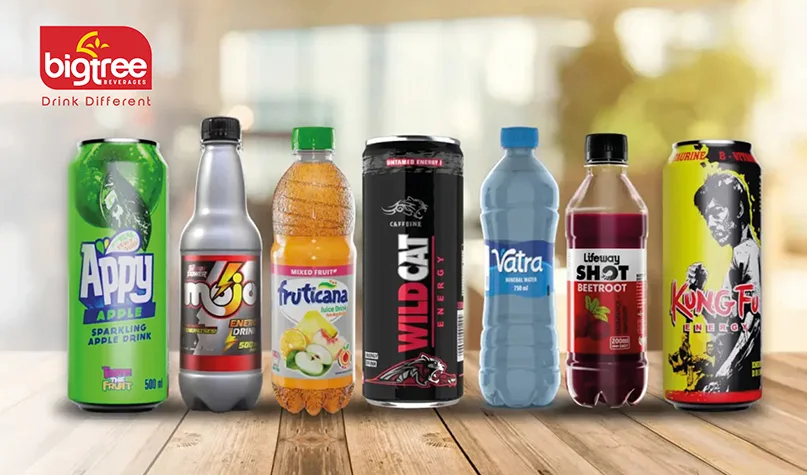
The brand’s portfolio includes Vatra, Fruiticana, Mojo Energy Drink, KungFu Energy, Brothers Premium – mocktails and mixers – Appy, and FruiTop.
To meet increasing product demand, BigTree Beverages has invested in hot-fill capability, in-house polyethylene terephthalate (PET) pre-formulated bottle and cap production, packaging development, and a route-to-market model that spans depots, distributors, modern and general trade, hotel, restaurant, and catering (HoReCa), and last-mile channels.
The brand has also built a flavour pipeline designed around African taste preferences and real-use case studies.
This combination of quality, speed, deep flavour understanding, technical capability, and route-to-market strength has driven industry-wide recognition.
For example, BigTree Beverages was named the South African Development Community’s (SADC) 2024-25 Exporter of the Year in the Large Enterprise category – a strong marker of the brand’s product competitiveness and regional relevance.
“Supply chains are built on trust long before they are tested by disruption. For a business of our scale, supplier and partner relationships are not peripheral; they are part of the operating model”
Mohsin Patel, Director, Trade Kings Group
LOCALLY DRIVEN INDUSTRIALISATION
Trade Kings’ latest business unit, Kingsworth Group Limited (Kingsworth), is strategically important to the company, enabling it to scale its manufacturing capability efficiently.
“It represents deeper industrialisation, not just expansion. It moves Zambia from importing key industrial inputs to producing them locally, which strengthens both Trade Kings and the wider manufacturing sector,” Patel highlights.
Indeed, Kingsworth is the country’s first integrated starch and glucose facility and a USD$110 million investment developed over two phases.
The plant will process locally grown maize into native and modified starch, liquid glucose, maltodextrin, corn germ, gluten meal and feed, dextrose, and related derivatives. These ingredients are used in confectionery, beverages, dairy, processed foods, pharmaceuticals, paper, adhesives, textiles, and animal nutrition.
As such, the brand reduces reliance on imported intermediates, helps stabilise costs and margins, strengthens value chain reliability, and makes future downstream expansion more viable as more of the input chain is under local control.
At full capacity, Kingsworth is designed to produce up to 140,000 tonnes of products annually, substitute around USD$30 million in imports each year, and unlock approximately USD$150 million in export potential through African Continental Free Trade Area (AfCFTA)-linked trade.
“Kingsworth is not just another business unit; it is a capability platform that makes the wider group stronger.”

BUILT ON TRUST
A robust and purpose-built supply chain is fundamental to the success of Trade Kings.
“Supply chains are built on trust long before they are tested by disruption. For a business of our scale, supplier and partner relationships are not peripheral; they are part of the operating model,” Patel shares.
The company works closely with local and regional suppliers to ensure strong manufacturing capabilities, which depend on reliable input workflows, practical coordination, and shared growth.
For instance, given Trade Kings is one of the largest industrial users of sugar in Zambia and a major buyer of milk from local dairy farmers, the company works closely with producers of maize, wheat, and potatoes that feed directly into its food processing businesses.
“Local sourcing matters because it shortens the supply chain, builds capability in-country, and strengthens the wider industrial base. Regional partnerships matter because scale increasingly depends on trade, not isolation,” he informs.
This is also where backward integration becomes important. Case in point, Kingsworth improves the stability of the value chain behind its finished products, whilst Dairy Gold’s milk collection model matters for the same reason.
“The more coordinated and dependable your upstream system is, the more competitive your downstream brands become,” Patel explains.
Equally integral to the company’s DNA is its 17,500+ employees, whose care, deep understanding, and swift problem-solving make the business what it is today.
“One of the things I value most about Trade Kings is that so much of the company’s strength sits in its people – on the plant floor, in engineering, quality, logistics, distribution, and the commercial teams that keep the business close to market.”
“We believe Africa cannot continue to only be only a consumption market – it must increasingly produce, brand, and distribute for itself. We want Trade Kings to be part of that next chapter”
Mohsin Patel, Director, Trade Kings Group
STRENGTHENED BRANDS
Trade Kings is continuing 2026 with a clear set of priorities – to deepen production capability, strengthen upstream control, expand intelligently across the region, and keep building brands that can travel the distance.
This means continuing to strengthen the company’s food and beverage platform through BigTree Beverages, BigTree Brands, and Dairy Gold.
It also means ensuring Kingsworth delivers for the group, namely stronger input security, more competitive downstream manufacturing, and a more stable industrial base.
Trade Kings also wants to continue investing in key categories such as confectionery, home care, and other core businesses that still have room to grow regionally, facilitated by moving ahead with its wider production expansion agenda that is already part of the company’s growth plan.
“We believe Africa cannot continue to only be a consumption market – it must increasingly produce, brand, and distribute for itself. We want Trade Kings to be part of that next chapter,” Patel closes.
TRADE KINGS GROUP PARTNER

This company profile was produced by the editorial team at Africa Outlook, a publication within the Outlook Publishing global network of B2B industry magazines.
Outlook Publishing showcases organisations and leadership teams shaping sectors including manufacturing, mining, construction, healthcare, supply chains, food production, and sustainability.
Africa Outlook highlights organisations driving growth, innovation, and investment across Africa’s evolving business landscape.