




Konkola Copper Mines is a leading integrated copper producer in Africa. In such an enviable position, we explore its four state-of-the-art mining operations and commitment to national development across Zambia.
THE PRIDE OF ZAMBIA
Located in the heart of Zambia, the Copperbelt Province is situated in a mineral-rich region spanning Central Africa.
Konkola Copper Mines (KCM) is at the helm of the province’s underground mining operations as one of the continent’s largest integrated copper producers, expertly leveraging mineral and human resources to enhance stakeholder value and become the pride of Zambia.
Equipped with over 13,800 employees and contractors, the company is headquartered in Chingola and spans four world-class mining operations.
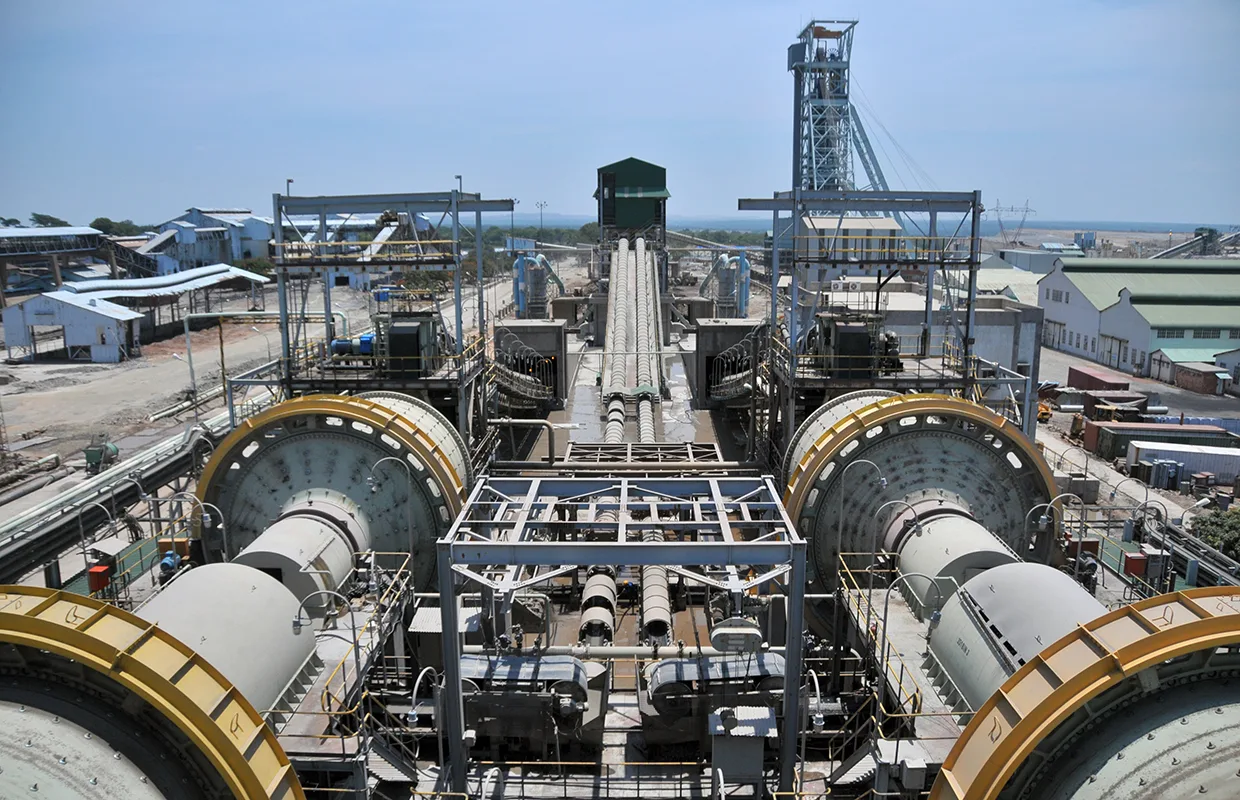
Its renowned Nchanga Mine comprises numerous open pits and processing plants, as well as two concentrators, a tailings leach plant (TLP), and the Nchanga smelter.
KCM’s Konkola Mine in Chililabombwe, meanwhile, comprises three operational shafts – No. 1, 3,
and 4.
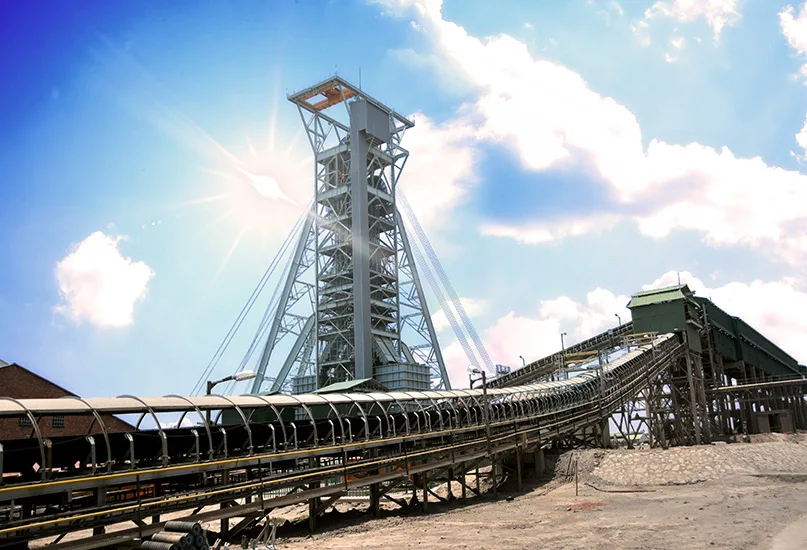
The latter is also home to the Konkola Deep Mining Project (KDMP), an approximately 1.5 kilometre (km)-deep mine used to explore and extract ore bodies further under the surface.
Located in Kitwe, KCM’s Nkana refinery refines and converts copper anodes from the smelter to cathode products for exportation.
Finally, the company’s Nampundwe Mine in the Shibuyunji District – west of Zambia’s capital city, Lusaka – produces leading pyrite used for the smelting process.
KCM’s client base comprises over 1,600 registered contractors and suppliers, making it a leading force in the country’s mining landscape.
UNLOCKING RESOURCES
The most recent developments at KCM’s KDMP include improvements to the company’s deepest pump station – located 985 metres (m) underground – which currently cannot mine ore safely below a level of 1,040 m due to mine dewatering constraints.
KCM’s current dewatered resource accounts for less than three percent of the company’s total resource. Therefore, the business requires a new pump station to be constructed at 1,390 m to allow for the dewatering of 283 million metric tonnes (Mt) of ore resource between levels of 1,040 m and 1,350 m.
The pump station infrastructure will have a nominal capacity of 290,000 cubic metres (cbm), utilising 22 multi-stage clear water pumps, eight settlers to remove suspended solids and ensure compliance with environmental limits, and an equal number of sumps to allow for a greater surge capacity in case of the pump station’s emergency stoppage.
Excavation works for this are to be commenced by the Australia-based Mancala Group at a total cost of USD$63 million, which will create approximately 200 local job opportunities with a projected duration of 26 months.
Following excavation works, the equipping and construction of the new pump station and electrical substations will take place, whilst infrastructure will be supplied to the existing pump stations situated 985 m, 660 m, and 370 m underground.
Watertight doors and penstocks required to contain water in the workings in case of an emergency will also be installed.
SUCCESS THROUGH COLLABORATION
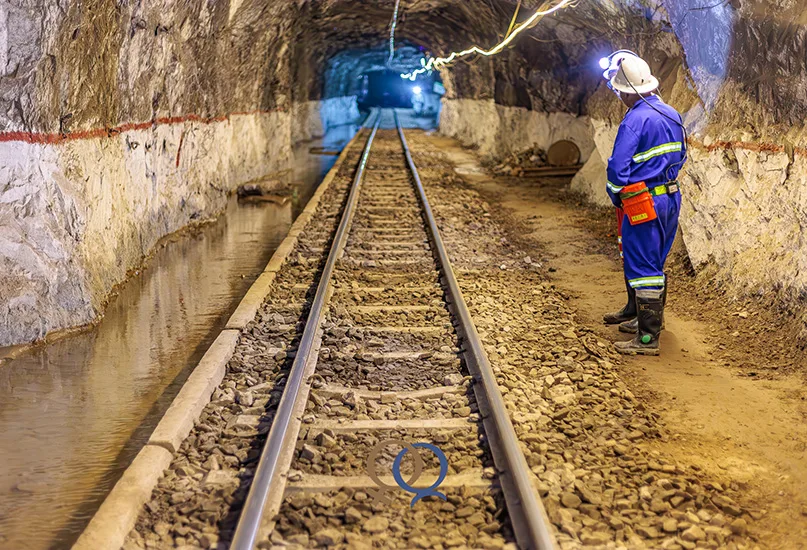
Alongside the construction of critical pump infrastructure, KCM has a number of additional ongoing projects across its mine portfolio.
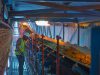
For instance, the company has reintroduced raise boring at the No. 3 shaft of its Konkola Mine after 15 years, with TUMI Raise Boring commencing drilling in April this year.
These drain holes are critical to dewatering previously inaccessible areas, improving underground safety and unlocking additional mining potential – both key enablers in stabilising mine conditions and increasing productive capacity.
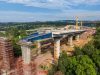
Elsewhere, KCM is collaborating on a high-speed railway rehabilitation project with Flint Rail Projects, comprising 5,934 km of rail expected to be completed by April 2026.
Such upgrades will enable higher train speeds, reduce cycle times, and significantly cut down on derailments and operational blockages, increasing tramming capacity from 850,000 tonnes per annum (tpa) to approximately 1.5 million tonnes per annum (Mtpa), before eventually achieving 4 Mtpa.
The railway investment project aligns with KCM’s overarching vision for modernisation and supporting Zambia’s ambitious national goal of producing three million tonnes of copper by 2030.
KCM is also undertaking exploration works in the form of surface diamond drilling, conducted for the purpose of upgrading an inferred resource of 223 kilotonnes (kt) of copper metal to an indicated category for underground operations.
Timaja Enterprises has been engaged to undertake the surface drilling programme, of which a total of 7,300 m has been planned to increase the confidence level of the inferred resource of mixed sulphide, where the average hole depth is 370 m.
This collaboration grants KCM the opportunity to increase its reserves and support the life of mine (LOM) plan through increased production.
A FINE-TUNED ENVIRONMENTAL POLICY
As one of Zambia’s largest underground mining companies, KCM deeply understands the impact its operations can have on the surrounding environment, particularly as many of its inherited mines and processing assets – which had been in operation for decades –suffered from numerous legacy environmental issues.
As such, KCM now has a comprehensive and well-funded programme designed to alleviate such issues, with particular focus being given to areas in proximity to local communities.
Indeed, the USD$2.9 billion programme has paved the way for substantial environmental projects in recent years.
One particularly noteworthy example is the commissioning of the Nchanga smelter, which has increased sulphur dioxide (SO2) capture and improved energy efficiency at the Nchanga Mine.
The Nchanga smelter meets benchmark environmental performance, as it captures approximately 99.6 percent of SO2 emissions, and uses 70 percent less fuel than the old smelter.
KCM’s recent environmental programme has also led to the commissioning of new concentrators at both the Nchanga and Konkola Mines, with updated machinery implemented to achieve zero discharge on operations that could harm the planet.
Other environmental management projects include the revamping of the piping and dam catchment for hydrometallurgical processing, which reduces run-off in areas most responsible for discharges.
TOUCHING HEARTS
Giving back to and supporting the community remains a key priority for KCM, as it strives to have a meaningful impact on the development of Zambia.
This is materialised through its extensive corporate social responsibility (CSR) programme, which aligns with national development goals and comprises four pillars – education, health, sport development, and sustainable livelihoods.
Over the years, KCM is proud to have supported One Way Mission Children’s Home – an orphanage in Chililabombwe currently providing a roof over the heads of 45 children.
KCM also provided funds to revamp a defunct poultry business that the home used to run in the past. This new venture not only provides much-needed income for the orphanage but also enhances food security, offers life skills training for the children, and supports their education.
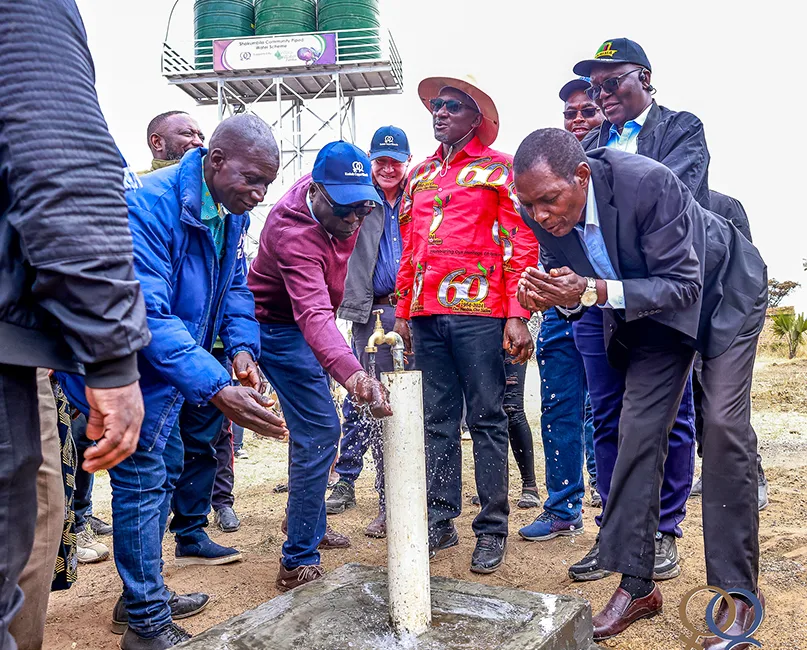
This initiative is one of many community development projects, which have also seen KCM support water sanitation projects, aid local clinics, and fund infrastructure, further emphasising the company’s socioeconomic significance in the region.
EMPOWERING ZAMBIA THROUGH EDUCATION
KCM’s continued community efforts can also be seen in its powerful educational initiatives, which facilitate tangible long-term benefits for future generations.
Since 2004, the company has run scholarships at primary, secondary, and tertiary levels for high achievers in Grades 7 to 9 at government schools.
KCM has also sponsored students’ college and university education both domestically and abroad, directly benefitting over 500 young people.
Following the introduction of free education from the Zambian government, the company announced the launch of the KCM-HELSB Scholastic Excellence Programme in collaboration with the Higher Education Loans and Scholarship Board (HELSB).
The programme aims to provide student loans for those pursuing tertiary education, with a focus on individuals from KCM’s operational areas, namely Chingola, Chililabombwe, Kitwe, and Nampundwe.
The company has committed USD$100,000 per year to support meritorious but underprivileged students, with funds managed transparently by HELSB.
The scholarship is underpinned by a revolving funding model, given in the form of a loan that beneficiaries pay back through established mechanisms after completion.
Significantly, the scholarship utilises merit-based selection, with HELSB overseeing a transparent selection and administration process to ensure the most deserving students benefit.
As such, KCM is empowering the workforce of tomorrow as it recognises the value of education in building resilient communities and driving national development.
The company wants to ensure young people are empowered with the much-needed skills that align with Zambia’s industrial and socioeconomic priorities.

CONTRIBUTING TO NATIONAL CHANGE
KCM strives to increase its production capacity through strategic investment and technological advancements. Thanks to the company’s strategic investment, operations have since restarted and production is steadily increasing.
Indeed, in August this year, KCM hit its highest production capacity at 8,200 tonnes per month (tpm) of copper. This demonstrates stable progress towards its objective of 10,000 tpm and 143,000 tpa by 2026, contributing 10 percent to Zambia’s target of 3 Mtpa by 2030.
Other future targets for KCM involve the expansion of the Nchanga smelter’s capacity from 311,000 tpa to 500,000 tpa, as well as developing two additional TLPs.
Once these expansions are completed, the company’s copper production target will increase to 500,000 tpa.
Additional key priorities for KCM involve setting up a cobalt plant at the Nchanga Mine to produce cobalt as opposed to a cobalt alloy.
Aside from the developments at KDMP, the company also intends to rehabilitate and operationalise the second stream at the concentrator to increase concentrate production for onward processing at the Nchanga smelter.
KONKOLA COPPER MINES PARTNERS